Protect Your Driveway During a Dumpster Rental
A loaded dumpster can dent asphalt or crack a stressed slab in hours. Here's what actually causes driveway damage and how to prevent it.
ReadChesapeake, VA guide
A practical sizing guide for roofing tear-off dumpsters in Chesapeake, VA, covering squares, layers, weight limits, and storm-season timing.
Roofing tear-offs are the single most common way a first-time renter picks the wrong dumpster. Someone measures the roof, thinks in terms of "how big is my house," and orders a container sized like they're clearing out a garage. Then the crew starts stripping shingles, the container fills to a third of its visible capacity, and the ticket comes back over the weight limit. Roofing debris is dense, it's wet more often than not in this part of Virginia, and it hits its tonnage ceiling long before it hits the top rail of the box. Getting the size right up front is the difference between one clean pickup and a second truck roll that eats into everybody's schedule.
We deliver roofing dumpsters all over Chesapeake and into Portsmouth, Suffolk, and Virginia Beach for roofing contractors running multiple crews a week and homeowners handling a single reroof alike. The sizing logic is the same in every case, and it starts with roofing squares, not square footage of the house.
A roofing square is 100 square feet of roof surface, and it is the unit every roofer already uses to order shingles, so it is the unit we use to size the dumpster. A typical single-story home in the Chesapeake area runs somewhere in the 15 to 25 square range depending on footprint and roof pitch. A larger two-story home with a complex roofline, dormers, or an attached garage can easily push past 30 squares. Steeper pitches also add surface area beyond what the footprint alone suggests, so a 2,000-square-foot ranch and a 2,000-square-foot two-story with a 10/12 pitch are not the same tear-off.
Once you know the square count, the next question is layers. A single layer removed down to the deck is one kind of job. Two layers — common on older homes where a previous reroof was installed over the existing shingles instead of tearing it off first — roughly doubles the debris weight for the same roof area. Three layers, less common now that most jurisdictions and manufacturers discourage it, still shows up often enough on older housing stock around the Chesapeake and Portsmouth waterfront that it's worth checking permit history before you order.
The table below is the starting point we use with roofing crews. Treat it as a guideline, not a guarantee — a heavier architectural shingle, wet debris after a rain delay, or a tear-off that includes old wood shakes underneath will all push actual tonnage higher than a like-for-like square count in dry three-tab shingles.
| Roof Size (squares) | Layers | Recommended Container | Notes |
|---|---|---|---|
| Up to 10 | 1 | 10 yard | Small home, addition, garage, or shed roof |
| 10 - 15 | 1 | 10 yard (tight) or 15 yard | 15 yard gives margin if debris runs heavy or damp |
| 15 - 25 | 1 | 15 yard | Typical single-layer tear-off on an average house |
| 15 - 20 | 2 | 20 yard | Second layer roughly doubles weight, not volume |
| 25 - 30 | 1 | 20 yard | Larger footprint or steep pitch, single layer |
| 20 - 30 | 2 or 3 | 20 yard, possibly two pulls | Multi-layer tear-offs on bigger roofs often need a swap-out |
| 30+ | Any | Two containers or a swap mid-job | Plan a second delivery rather than oversizing one box |
Notice that we rarely recommend anything larger than a 20 yard for roofing, even on big houses. That's deliberate. A 30 yard box sounds like the safe choice, but on a tear-off it almost never fills to capacity before it hits its weight allowance, so you end up paying for volume you can't use. It's usually cheaper to run a 20 yard, get it weighed and hauled, and bring a second container back for the rest of a large or multi-layer job than to rent one oversized box that's still mostly empty when the scale says it's full.
This is the part that trips up first-time renters. A 20 yard dumpster can physically hold a lot of material by volume, but roofing debris hits its tonnage limit well before the box looks full. Asphalt shingles run roughly 200 to 400 pounds per square depending on the shingle type — three-tab versus architectural — and how many layers are being removed. Stack a second or third layer on top of that, add the felt paper, flashing, and any deck sheathing coming off with it, and a modestly sized roof can generate several tons of debris in a surprisingly small footprint.
Wet weather makes this worse. Shingles that have absorbed rainwater during a tear-off that gets interrupted, or debris that sits in the container overnight in Chesapeake's humidity, can weigh noticeably more than the same pile removed dry. If a crew has to pause mid-roof because of an afternoon thunderstorm — common in the summer months here — plan for the container to come in heavier than the dry-weather estimate suggests.
The practical takeaway: size the container to the weight allowance that comes with it, not to how much empty space you think you'll have left. If you're near the top of a size bracket in the table above, or unsure how many layers are coming off until the crew gets into it, it's worth a call before delivery so we can talk through stepping up a size or planning a swap.
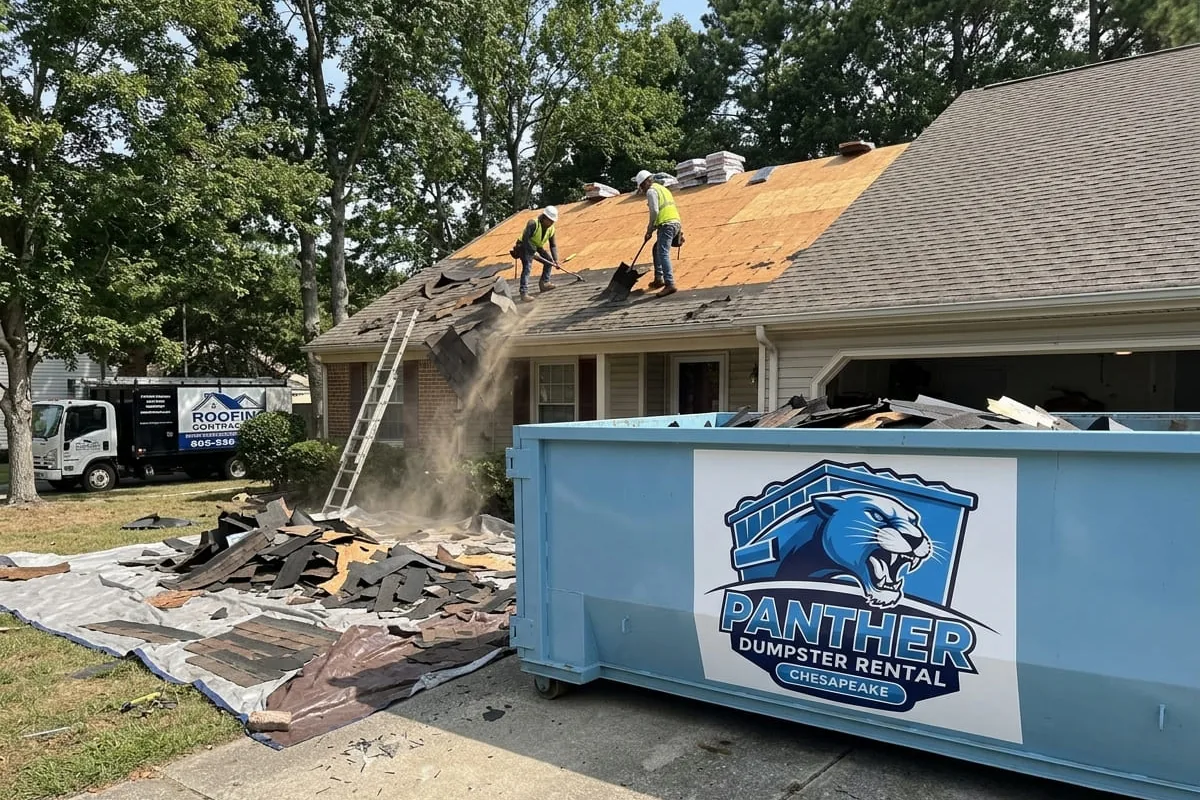
Roofing crews work fast, and dumpster placement should support that pace, not slow it down. The goal is to position the container as close to the eave and the work area as possible so shingles can be pitched directly off the roof or down a chute into the box, rather than carried across the yard. On most residential lots that means placing the container in the driveway, positioned under or immediately adjacent to the section of roof coming off first.
A few placement details matter more on a tear-off than a general cleanout:
We coordinate placement with the roofer or homeowner before the truck leaves the yard, because moving a loaded roofing dumpster after the fact isn't a quick fix — it's a second truck visit.
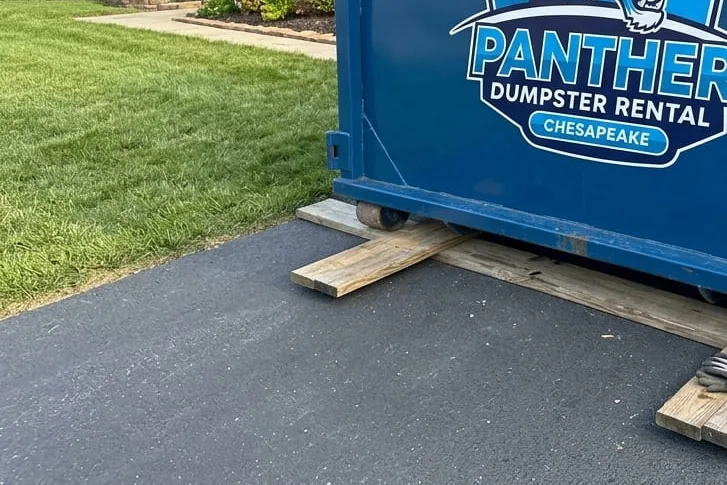
A loaded roofing dumpster is heavy, and it sits on a concentrated set of contact points — either steel rails or a small number of wheels, depending on container style. On an asphalt driveway, especially in summer heat when the surface has softened, that weight can leave rut marks or indentations if the container sits for several days without protection. Concrete driveways handle it better but aren't immune to chipping at the edges where a delivery truck maneuvers tight.
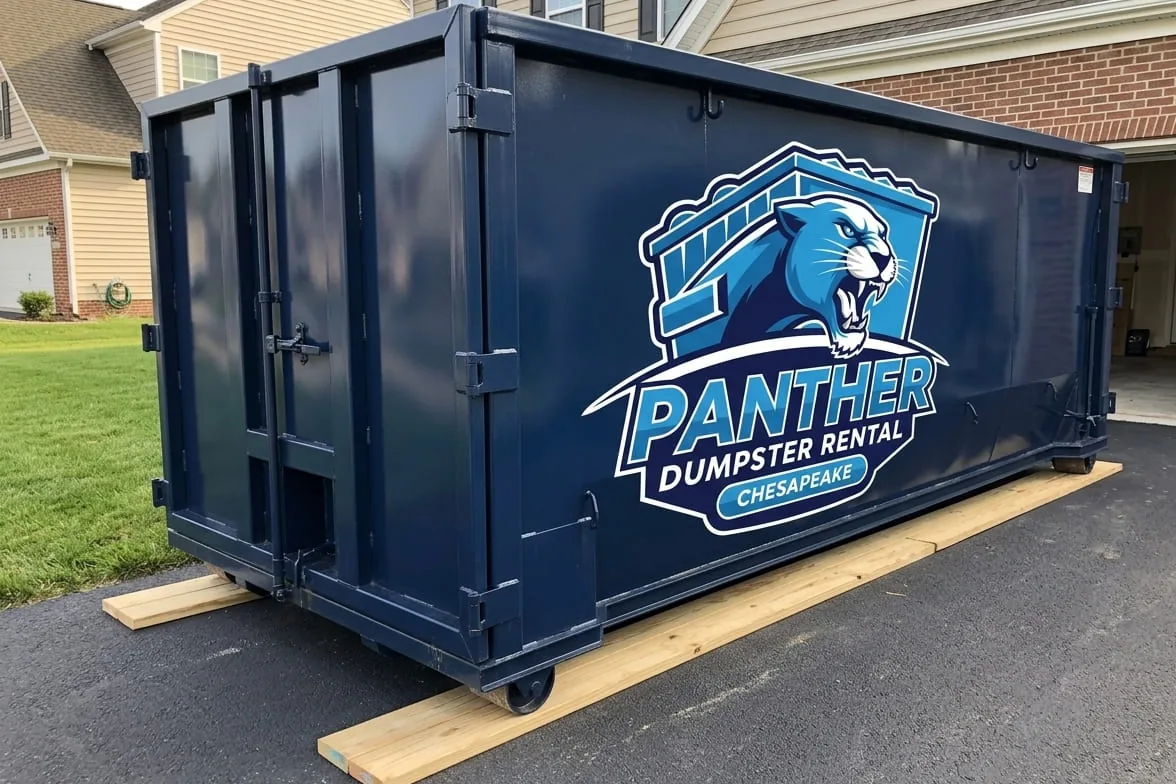
Standard practice on every tear-off is to run wood boards — 2x10s or plywood sheets — under the container's contact points before it's set down. It takes a few minutes and it's the single best way to prevent driveway damage, particularly on jobs that sit two or three days while a crew works through a large or multi-layer roof. Near the placement zone, moving planters, cutting back low shrubs, and marking sprinkler heads or shallow irrigation lines before delivery saves everyone a headache — a fully loaded dumpster isn't something we reposition on a whim once a crew has started working around it.
Roofing schedules here run on two clocks: the calendar and the weather forecast. Hurricane season runs roughly June through November, and much of the roofing work we support during those months is either storm-prep replacement — homeowners and property managers getting an aging roof off before the next system tracks toward Hampton Roads — or storm-damage repair after wind or hail has already done the damage. Either way, turnaround matters more than usual. A roof torn off and waiting on shingles when a storm is approaching is a serious exposure problem, so crews want the dumpster on site fast, filled fast, and off the property fast so the new roof can go on before a rain event.
That urgency shapes how we schedule delivery and pickup during storm season. We build in same-day or next-day pickup availability for tear-off jobs when a system is in the forecast, and we'd rather get a call two days ahead of a projected landfall than have a contractor find out on the day that a truck can't get out to them. Booking early during an active storm watch is the single best thing a roofer or property owner can do to avoid a scheduling scramble.
Summer heat brings its own considerations even outside storm season. Chesapeake summers run hot and humid, and that heat softens asphalt driveway surfaces enough that protection boards matter more in July and August than in cooler months. Heat also means crews often want to start tear-offs early and finish before the worst of the afternoon heat and the pop-up thunderstorms common on summer afternoons here — another reason early, on-time delivery matters. A dumpster that shows up late can cost a crew its best working hours.
On jobs booked through a contractor rather than directly with the homeowner, communication between the crew's schedule and our delivery window is what keeps the job moving. A few things we confirm on every tear-off booking:
Contractors running multiple crews across Chesapeake, Portsmouth, Suffolk, and Virginia Beach in the same week benefit most from a standing relationship rather than booking each job as a one-off — fewer surprises on delivery windows, faster response when a job runs long or a storm forecast shifts the timeline. Whether you're a roofer managing several tear-offs a month or a homeowner handling one reroof, the sizing principles are the same: count your squares, know your layers, size for weight rather than volume, and plan pickup around how fast the crew can strip the roof.
Talk to a real person
Call and describe the job. Flat price, stated tonnage, and a delivery time on the same call.
Mon–Sat 7:00am – 6:00pm · Sun by appointment
From this guide
For most single-layer tear-offs in the 15 to 25 square range, a 15 yard container is the right fit. Smaller roofs under about 15 squares can often work with a 10 yard, while larger single-story homes or steeper roofs pushing past 25 squares are usually better matched to a 20 yard so you're not close to the weight limit before the roof is fully stripped.
Usually yes, but the change is about weight allowance more than size. A second layer roughly doubles the shingle weight coming off the same roof area, so a roof that would need a 15 yard for a single layer often needs a 20 yard for a two-layer tear-off, even though the physical volume of debris hasn't changed nearly as much as the tonnage has.
Roofing debris is dense. Asphalt shingles run roughly 200 to 400 pounds per square depending on the shingle type and number of layers, so a container can reach its tonnage limit while still having plenty of visible space left inside. That's why roofing dumpsters are sized and priced around weight allowance rather than how full the box looks.
As close as the driveway and site allow, ideally tight to the eave where the crew is working so shingles can be pitched or chuted directly into the container. We check overhead clearance, gutter and landscaping obstacles, and drop distance before delivery so the crew isn't losing time carrying debris across the yard.
During hurricane season we prioritize fast turnaround for tear-off jobs, and we'd rather get a call a day or two ahead of an approaching storm than a same-day request once a watch is issued. Booking early gives us the best chance of hitting the delivery and pickup window a roofing crew needs to get a new roof on before weather arrives.
Keep reading
A loaded dumpster can dent asphalt or crack a stressed slab in hours. Here's what actually causes driveway damage and how to prevent it.
ReadDownsizing, decluttering, or prepping to sell? Here's a room-by-room Chesapeake cleanout checklist, plus how to size the dumpster right the first time.
ReadA practical, no-filler guide to how recycling and disposal actually work in Chesapeake, VA, including what a dumpster can and can't take.
Read