What Size Dumpster Do I Need? Chesapeake VA Guide
Weight and volume aren't the same limit. Here's how to size a roll-off correctly for your material, plus real driveway access numbers for Chesapeake.
ReadChesapeake, VA guide
A practical, no-filler guide to how recycling and disposal actually work in Chesapeake, VA, including what a dumpster can and can't take.
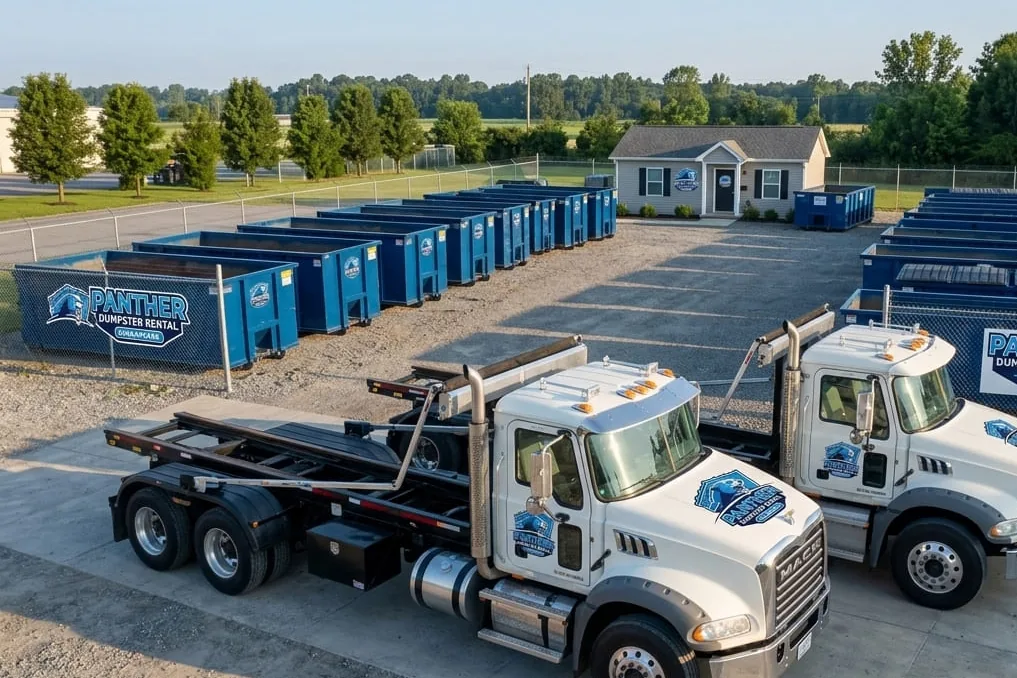
If you have ever wondered what actually happens after a dumpster gets picked up from a Chesapeake driveway, the short answer is: it goes to a transfer station, gets sorted or consolidated, and moves on to a landfill, a recycling processor, or a specialty facility depending on what is in the load. Chesapeake does not run its own landfill. Like the rest of South Hampton Roads, the city relies on a regional authority for the heavy lifting of waste disposal, and understanding that system explains why some materials belong in a roll-off dumpster and others need a dedicated trip elsewhere.
This guide walks through how disposal actually works here: the transfer station Chesapeake residents and haulers use, the regional authority behind it, what gets recycled versus landfilled, where household hazardous waste and used motor oil go, why scrap tires are treated differently under Virginia law, and what a dumpster rental company like Panther Dumpster Rental can and cannot legally or practically load into a container.
Chesapeake, Virginia is an independent city, not a county or a township inside a county. There is no "Chesapeake County" — the city is its own governing jurisdiction, separate from Virginia Beach, Suffolk, Portsmouth, Norfolk, and every other city around it. That matters for waste management because independent cities in Virginia typically do not build and run their own landfills. Instead, several of the South Hampton Roads cities pooled their disposal infrastructure decades ago into a shared regional authority rather than each building duplicate facilities.
For Chesapeake, that regional authority is SPSA — the Southeastern Public Service Authority. SPSA is not a Chesapeake-only operation. It is a multi-jurisdictional authority that serves several member communities across South Hampton Roads, pooling disposal capacity, transfer infrastructure, and specialty collection programs so that no single city has to fund all of it alone. Chesapeake is one of several member localities, alongside neighboring cities in the region. When you drop off a load at a Chesapeake facility, you are plugging into a system that also handles waste from residents and businesses in other SPSA member communities, not a Chesapeake-only pipeline.
The facility most residents, contractors, and haulers deal with directly is the Chesapeake Transfer Station at 901 Hollowell Lane, Chesapeake, VA 23320. It is operated by SPSA and functions as a transfer station rather than a landfill — meaning municipal solid waste delivered there is consolidated and loaded onto larger transfer trailers for onward hauling, rather than buried on site. For a homeowner clearing out a garage or a contractor closing out a renovation, the transfer station is the practical drop-off point for general trash that is not going out in a Panther roll-off.
Beyond general municipal solid waste, the Chesapeake Transfer Station also hosts separate collection programs that run alongside — but are distinct from — the regular trash stream. Household hazardous waste collection and used-motor-oil drop-off are the two most relevant to homeowners, and both are handled as their own dedicated streams rather than being mixed in with ordinary garbage or construction debris. Treating them separately is not bureaucratic red tape; hazardous materials and motor oil require different handling, storage, and downstream processing than solid waste, so keeping them out of the general trash load protects both the workers handling the material and the equipment processing it.
Recycling in Chesapeake generally follows the same pattern as most of the country: clean, sorted, commonly-accepted materials such as cardboard, paper, aluminum and steel cans, and certain plastics can be diverted from the landfill stream through curbside recycling or drop-off recycling collection. Materials that are contaminated, mixed with food waste, wet, or not on the accepted list end up in the landfill stream through the transfer station regardless of what they are made of.
The practical challenge for most households and jobsites is not knowing that recycling exists — it is knowing what actually gets accepted. Grease-soaked pizza boxes, plastic bags, garden hoses, and many "recyclable-looking" plastics are common contaminants that get pulled and landfilled anyway because they either cannot be processed by the sorting equipment or would contaminate an entire batch of otherwise-good material. When in doubt on a specific item, checking with SPSA or the City of Chesapeake's solid waste division before tossing it in a recycling bin is more reliable than guessing.
Construction and demolition debris — drywall, lumber, roofing shingles, flooring — is a separate category again. Some of it can be recycled through specialty processors, but most mixed construction debris from a typical renovation ends up landfilled because separating it into pure material streams on a residential job is rarely practical. This is one of the main reasons dumpster rental exists: it gives a household or contractor one container for the mixed debris genuinely headed for the landfill, rather than requiring a dozen separate trips.
Household hazardous waste covers the products under most kitchen and garage sinks that are flammable, corrosive, reactive, or toxic: old paint and paint thinners, pesticides and herbicides, pool chemicals, propane cylinders, batteries, fluorescent bulbs, and similar products. These items are collected through a dedicated household hazardous waste program tied to the Chesapeake Transfer Station, separate from the general trash and separate from any dumpster rental.
The reason this matters practically: a roll-off dumpster is designed for bulk solid waste, not for chemical products. Loading paint cans, propane tanks, or pesticide containers into a rental dumpster creates a real safety hazard for the crew loading and hauling it, can contaminate the rest of the load, and in many cases is simply against the terms of the rental agreement. If you are clearing out a garage and find old chemical products mixed in with the junk, the right move is to set those items aside for the household hazardous waste collection program rather than tossing them in with everything else.
Used motor oil is collected as its own stream at the Chesapeake Transfer Station, separate from general household hazardous waste and completely separate from solid waste disposal. This is standard practice nationally because used oil is relatively easy to collect cleanly and has real recycling value once it is kept uncontaminated by other fluids or debris — but only if it is dropped off through the correct channel rather than poured out, mixed with other waste, or loaded loose into a dumpster.
Anyone doing DIY vehicle maintenance in Chesapeake — an oil change, a transmission fluid swap — should plan on taking the used fluid to the transfer station's used-oil drop-off rather than trying to dispose of it any other way. It should never go into a storm drain, onto the ground, or into a rental dumpster, where it can leak, contaminate other materials, and create disposal problems downstream.
Tires get their own section here because Virginia law treats them as a distinct category with real legal consequences for improper accumulation. Under Code of Virginia § 10.1-1418.2, it is illegal to accumulate more than 100 waste tires on a property without a permit. A knowing violation is a Class 1 misdemeanor, and accumulating 500 or more tires escalates the offense to a Class 6 felony. That statute exists because large uncontrolled tire piles are fire hazards and breeding grounds for mosquitoes, and Virginia has had real problems with abandoned tire dumps in the past.
What that means practically for a Chesapeake homeowner or small property owner: if you have a handful of old tires from a vehicle, they should go through a dedicated tire recycling or drop-off route rather than piling up on the property "for later" and rather than being tossed into a general dumpster. Most dumpster rental companies, Panther included, either exclude tires from a standard container load or handle them as a separate line item, precisely because tires are bulky, do not compact well, and are subject to their own regulatory framework distinct from ordinary solid waste.
A rented roll-off dumpster is built for the bulk of a cleanout or renovation: general household junk, furniture, mixed construction debris, yard waste in reasonable volume, flooring, cabinetry, and similar solid waste. That is the category of material the Chesapeake Transfer Station's municipal solid waste stream is built to receive, and it is what a Panther container is priced and designed to haul.
What does not belong in that same container is anything needing its own regulated route: household hazardous waste (paints, chemicals, pesticides, propane), used motor oil and other automotive fluids, and — outside of small quantities discussed with your driver in advance — scrap tires. A few other items, such as appliances containing refrigerant, may also carry their own handling requirements, which is why it is worth a quick call before loading anything questionable into a container.
The table below is a quick-reference summary of how the most common categories of household and jobsite material are typically routed in Chesapeake. It is a general guide, not a substitute for confirming specifics with the Chesapeake Transfer Station or your Panther driver for anything unusual.
| Material Type | Typical Route | Notes |
|---|---|---|
| General household junk, furniture, mixed debris | Dumpster | Standard load for a Panther roll-off container |
| Construction and demolition debris (drywall, lumber, flooring) | Dumpster | Most mixed C&D goes to the landfill stream via the transfer station |
| Cardboard, paper, cans, accepted plastics | Recycling | Must be clean and unmixed with food waste or bagged trash |
| Paint, pesticides, pool chemicals, propane cylinders | Hazardous drop-off | Household hazardous waste program at the transfer station, never a dumpster |
| Used motor oil and automotive fluids | Special program | Dedicated used-oil drop-off at the transfer station |
| Scrap tires | Special program | Subject to Va. Code § 10.1-1418.2 accumulation limits; not a standard dumpster item |
| Batteries and fluorescent bulbs | Hazardous drop-off | Handled through household hazardous waste collection, not curbside trash |
| Yard waste (branches, leaves, clippings) | Dumpster or municipal program | Reasonable volumes work in a dumpster; check for a separate yard waste option for large jobs |
Because South Hampton Roads is made up of several independent cities packed close together, a lot of disposal questions do not stop at the Chesapeake city line. Panther Dumpster Rental, based at 2324 Chesapeake Square Ring Rd in Chesapeake, delivers containers throughout Chesapeake and into the neighboring independent cities of Portsmouth, Suffolk, and Virginia Beach. Each of those cities has its own municipal solid waste arrangements, but the regional SPSA system means the underlying disposal infrastructure — including facilities like the Chesapeake Transfer Station — often serves more than one jurisdiction at once.
If you are planning a cleanout, renovation, or jobsite project anywhere in that four-city area and are not sure whether a particular material belongs in a rented dumpster or needs its own drop-off trip, the short version is this: solid, non-hazardous debris goes in the dumpster; chemicals, oil, and tires each have their own dedicated route. When in doubt, a quick call before loading saves a headache later — both for getting the load hauled cleanly and for staying on the right side of Virginia's waste regulations.
Talk to a real person
Call and describe the job. Flat price, stated tonnage, and a delivery time on the same call.
Mon–Sat 7:00am – 6:00pm · Sun by appointment
From this guide
No. Chesapeake is an independent city with no county government, and it does not operate its own landfill. Waste from Chesapeake moves through the Chesapeake Transfer Station at 901 Hollowell Lane, which is operated by SPSA, a regional public service authority that serves multiple South Hampton Roads communities rather than Chesapeake alone.
SPSA, the Southeastern Public Service Authority, is a regional authority that manages waste disposal infrastructure for several member localities across South Hampton Roads. Chesapeake is one of several member communities, so facilities like the Chesapeake Transfer Station handle material from more than just Chesapeake residents and haulers.
No. Those are household hazardous waste and need to go through the dedicated household hazardous waste collection tied to the Chesapeake Transfer Station, not into a general dumpster. Mixing chemical products into a solid-waste load creates a safety hazard for the crew and is typically against rental terms.
Used motor oil should be taken to the used-motor-oil drop-off at the Chesapeake Transfer Station, which runs as its own collection stream separate from general trash and separate from household hazardous waste. It should never be poured out, mixed with other fluids, or placed in a rental dumpster.
Under Code of Virginia § 10.1-1418.2, accumulating more than 100 waste tires on a property without a permit is illegal, and knowingly doing so is a Class 1 misdemeanor (a Class 6 felony at 500 or more tires). Tires should go through a dedicated tire recycling or drop-off route rather than piling up or going into a standard dumpster load.
Keep reading
Weight and volume aren't the same limit. Here's how to size a roll-off correctly for your material, plus real driveway access numbers for Chesapeake.
ReadFlat-rate dumpster pricing in Chesapeake isn't one number for every job. Here's what's actually built into that price, and what pushes it up.
ReadA straight answer on what belongs in your roll-off and what doesn't, plus where Chesapeake-area homeowners take the stuff that isn't allowed.
Read