
Weight, not volume
Concrete & Heavy Debris Dumpster Rental Chesapeake VA
Concrete, brick, block, asphalt and dirt break every ordinary rule of thumb about container size. A small, purpose-built heavy box is the right tool, and a clean load is the cheapest one you can send.
- Licensed & insured
- Same-day delivery
- Flat-rate pricing
- Locally owned
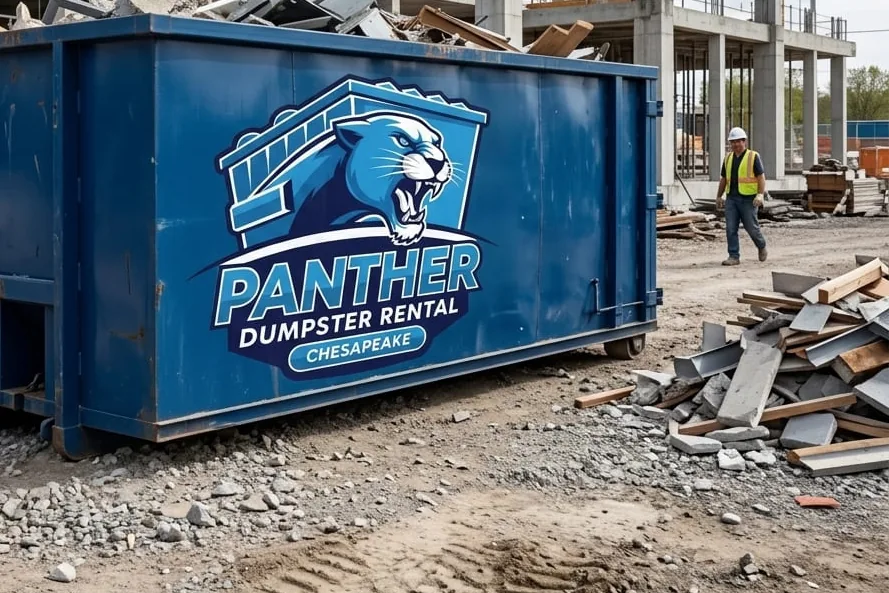
Concrete & Heavy Debris Dumpster Rental Chesapeake VA across Chesapeake and Portsmouth
Dense material inverts what most people assume about renting a container. Normally you run out of room before you run out of weight allowance. With concrete and similar debris, you run out of weight while the box still looks nearly empty, and the mental picture of a "full container" is exactly the picture that gets a load turned away. A cubic yard of broken concrete weighs roughly a ton and a half to two tons — a large container filled to the top with masonry would weigh far more than any roll-off truck can legally or safely haul.
So heavy debris is a different product with different rules: a smaller box, low walls, a clearly marked fill line, and a load kept clean of anything that is not masonry. Get those four things right and this becomes one of the most straightforward jobs we run. Get them wrong and it becomes the one that costs the most and holds up the rest of the project.
Why a small container is the right container for heavy material
The 10 or 15 yard container exists specifically for this kind of work. Low walls make it easy to tip a wheelbarrow load over the side without a ramp, a shorter footprint fits a tighter driveway, and the capacity reaches a legal payload well before it runs out of room. Ordering a bigger box for concrete means ordering a container you are not actually allowed to fill.
- Broken concrete — roughly a ton and a half to two tons per cubic yard, so figure a foot or two of depth in the container, not a full box
- Brick and block — somewhat lighter than solid concrete, but the same sizing logic applies
- Asphalt — heavy, and best kept as a clean load since it typically has recycling value
- Soil, sod and stone — wet soil after a Chesapeake rain event is noticeably heavier than dry soil, so account for recent weather when estimating
Tile and thin-set from a bathroom or kitchen strip-out sits in a slightly different category worth calling out on its own. It reads as light demolition debris rather than masonry to a lot of homeowners, since a single tile weighs almost nothing in your hand, but a full room's worth of floor and wall tile plus the mortar bed underneath adds up fast and belongs in the same weight-first thinking as concrete and brick rather than in a general container sized for cabinetry and fixtures.
Multiple smaller pulls also tend to work better with how most heavy-debris jobs actually get done in practice. Breaking up a driveway or a patio is physical work regardless of who is doing it, and a lot of homeowners and even some contractors tackle it in sections over a couple of days rather than all at once. Timing a 10 yard pull to match that pace, rather than committing to one large container sitting mostly empty while the work slowly catches up to it, usually ends up both cheaper and easier to manage.
Fill lines, and why we mark them
On heavy loads, the driver marks a fill line, and it is not a suggestion. A container loaded past a safe payload cannot be winched onto the truck without real risk to the cable, the rails and whatever is parked nearby, and it cannot legally travel the road afterward. If the marked line sits at a foot and a half, that line is the top of the load — not a starting point.
Load it evenly across the floor of the container rather than piling everything near the door. A container with all its weight concentrated at one end sits poorly on the truck bed and is genuinely more dangerous to haul. Resist the urge to top off a masonry load with a bag or two of general trash just because there is visible room above the fill line — that single decision turns a clean, recyclable load into a mixed one that costs considerably more to process.
Clean concrete is the cheapest heavy load there is
Concrete, brick and clean masonry debris have real recycling value once crushed into aggregate, and processors want that material clean. A container holding nothing but broken concrete has a straightforward, lower-cost path through the system. The same container with a few bags of general trash, a length of lumber or an old fixture mixed in becomes a contaminated load that has to be picked apart before it can be processed at all.
Keep the load clean and this stays simple. Rebar embedded in broken slab or footing material is generally fine, since it gets separated out during crushing — the problem items are plastic sheeting, wood forms, insulation and general household or construction rubbish that has nothing to do with the masonry itself.
Old asphalt driveways being replaced deserve their own note here, since Chesapeake's hot, humid summers soften asphalt in a way that makes some homeowners assume it should be handled differently than concrete. It should not, at least not for disposal purposes — cured, removed asphalt millings and slab are dense and recyclable in the same way concrete is, and belong in the same size-down, fill-line, clean-load approach. The softening only matters while the asphalt is in place and being worked; once it is broken up and in the container, it behaves like any other heavy masonry debris.
Excavation, pool removal and other heavy-debris jobs beyond a driveway
Driveways and patios are the most common heavy-debris job, but they are far from the only one. Pool removal — breaking up and removing an old in-ground pool shell — produces a genuinely large volume of concrete and gunite that needs to be planned across multiple pulls rather than treated as a single container job. Foundation and footing excavation for additions or new structures produces a mix of concrete, soil and sometimes old brick or block from a structure that used to sit there, and each material within that mix behaves differently by weight.
Excavation soil deserves its own mention, since it is easy to underestimate. A cubic yard of soil, especially wet clay-heavy soil common in parts of Chesapeake after a rain event, can run close to the weight of broken concrete, and property owners doing their own landscaping or drainage work sometimes assume dirt is a light, easy load in the way that leaves or brush are. It is not. Dirt and clay belong in the same size-down, fill-line approach as concrete rather than being treated like ordinary yard debris, even though it looks similar at a glance.
- Plan pool removal and large excavation jobs across multiple container pulls from the start
- Treat foundation debris as a mix — separate concrete, brick and soil where the job allows it
- Do not assume dirt is a light load — wet clay-heavy soil can weigh close to broken concrete
- Ask us to walk through a multi-pull plan before the job starts rather than mid-excavation
Which size suits the job
For concrete, brick, block, asphalt and dirt, size down rather than up. A 10 yard filled to a marked line comfortably handles a driveway or patio removal, a small foundation, or a modest excavation load. Larger heavy-debris jobs are almost always better served by two 10 or 15 yard pulls than by attempting one oversized container that can never legally reach its own rails.
DIY projects deserve a slightly more conservative estimate than a contractor job, mostly because a homeowner breaking up their own patio or walkway for the first time tends to underestimate both the volume that comes out of a given footprint and how much heavier it feels once it is actually in a wheelbarrow rather than sitting flat on the ground. If this is your first heavy-debris project, it is worth rounding up on the size estimate and talking through the square footage with us on the phone rather than guessing at a yardage from a mental picture of the finished pile.
- Estimate volume conservatively — dense material fills a legal payload with far less visible volume than it feels like it should
- Load flat and even, never heaped at one end
- Keep the load free of anything that is not masonry — trash, wood and plastic all contaminate an otherwise recyclable load
- Account for recent rain when estimating soil weight, since wet soil is noticeably heavier than dry
- Plan on multiple pulls for a large job rather than one container that cannot legally hold it all
Sizes
Which container for concrete & heavy debris?
Every service runs in all four sizes. Match the material to the weight allowance and the rest takes care of itself.
| Size | Dimensions | Capacity | Weight included | Best for |
|---|---|---|---|---|
| 10 Yard Dumpster | 12 ft long × 8 ft wide × 3.5 ft high | about 3 pickup truck loads | 1–2 tons | Small bathroom remodels, single-room cleanouts, concrete and heavy debris, roofing up to about 15 squares. |
| 15 Yard Dumpster | 16 ft long × 8 ft wide × 4 ft high | about 4–5 pickup truck loads | 2–3 tons | Attic and garage cleanouts, kitchen remodels, medium roof tear-offs, small deck removals. |
| 20 Yard Dumpster | 22 ft long × 7.5 ft wide × 4.5 ft high | about 6 pickup truck loads | 3–4 tons | Whole-home decluttering, flooring and siding jobs, large tear-offs, drywall and mud phases. |
| 30 Yard Dumpster | 22 ft long × 8 ft wide × 6 ft high | about 9 pickup truck loads | 4–5 tons | Full-house renovations, new construction, estate clearances, commercial fit-outs and demolition. |
| 40 Yard Dumpster | 22 ft long × 8 ft wide × 8 ft high | about 12 pickup truck loads | 5–6 tons | Large commercial fit-outs, industrial clear-outs, major renovations and high-volume light debris. |
Talk to a real person
Need concrete & heavy debris in Chesapeake?
Call (757) 432-2979 and describe the job. You will get a flat price and a delivery time on the same call — most orders before noon go out the same day.
Mon–Sat 7:00am – 6:00pm · Sun by appointment
Answers
Concrete & Heavy Debris — your questions
How much concrete actually fits in a 10 yard dumpster?
Considerably less than the yardage number suggests. Broken concrete runs roughly a ton and a half to two tons per cubic yard, so a legal payload is reached with only a foot or two of material across the floor of the container. The driver marks a fill line, and that line is the actual top of the load regardless of how much visible room remains above it.
Why can't I use a bigger dumpster for concrete or brick?
Because the truck sets the real limit, not the container. A large box filled with masonry would weigh far more than a roll-off truck can safely winch or legally carry on the road. Smaller heavy-debris containers are built for exactly this: low walls for easy loading, a shorter footprint, and a capacity that reaches legal payload before running out of physical room.
Can I mix concrete with other debris in the same container?
We would strongly recommend against it. Clean concrete and brick have real recycling value once crushed into aggregate, which keeps disposal costs down for a clean load. Add general trash, wood or plastic and the load becomes contaminated, which means it has to be sorted before it can be processed and typically costs more as a result.
Is rebar in the concrete a problem?
Generally, no. Reinforcing steel gets separated out during the crushing process, so ordinary rebar embedded in broken slab or footing material is normal and expected. What actually causes problems is everything unrelated to the masonry itself — wood forms, plastic sheeting, insulation and general rubbish mixed into the load.
Will a heavy load damage my driveway?
It is the highest-risk load type for that reason, which is exactly why boards go under the rails as standard on every driveway placement. The bigger factor is the existing condition of your surface — older concrete or asphalt driveways sometimes have cracking that is not obvious until weight is applied. Point it out to the driver and we can often set the container at the curb or on the street instead.
Service area
Concrete & Heavy Debris across South Hampton Roads
We run roll-off dumpsters out of our 2324 Chesapeake Square Ring Rd yard across every corner of Chesapeake — from Great Bridge and Greenbrier out to Deep Creek, Western Branch and South Norfolk, down to Hickory and Grassfield near the North Carolina line, and across the city lines into Portsmouth, Suffolk and Virginia Beach. If your neighborhood is not on this list, call us anyway. We probably still get there.