
Handled with care
Estate Cleanout Dumpster Rental Chesapeake VA
Clearing a family home is not a weekend errand. Longer rentals, quiet scheduling, and a container sized for a house nobody has fully seen inside of in years.
- Licensed & insured
- Same-day delivery
- Flat-rate pricing
- Locally owned
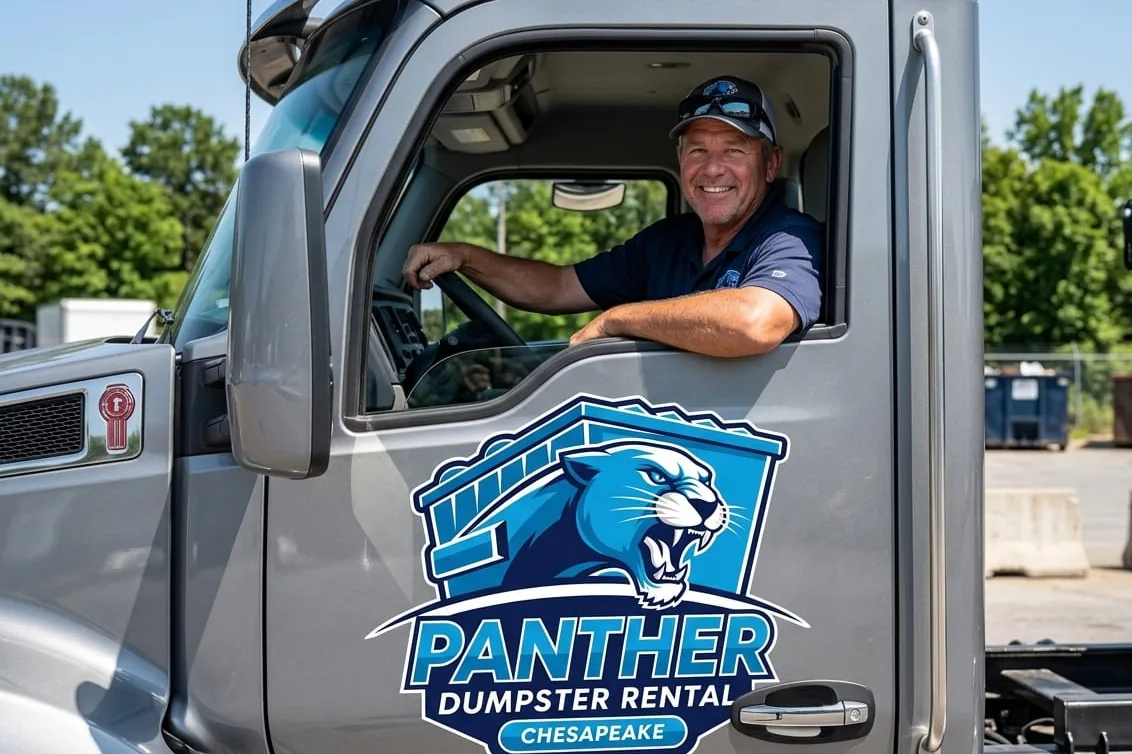
Estate Cleanout Dumpster Rental Chesapeake VA across Chesapeake and Portsmouth
These jobs run on a different clock than a typical cleanout. Somebody has passed away or moved into care, family is often scattered across several states, and a house has to be cleared before a sale that already has a date attached to it. None of that is helped by a container that has to go back after a few days. We rent longer on estate work as a matter of course, and we would rather you called to extend than rushed through a room you will regret rushing.
We also keep it low-key. The truck arrives when you ask it to, the driver does not need a tour of the house, and delivery is handled in a way that does not announce to the whole street what is happening. Some families want the container tucked to the side of the property. Others want it gone before the neighborhood is up on a weekend morning. Both are easy to arrange if you say so when you book.
Do the important parts first, before anything goes in the container
The most common regret we see on these jobs is speed. Before anything goes in the container, it is worth walking every room once with a box for paperwork and a box for anything that might have real value. Deeds, insurance papers, savings documents and photographs turn up inside books, in coat pockets and taped behind drawers, and none of that survives a container run once it is in.
- Paperwork first — deeds, titles, tax records, financial correspondence, anything the estate's attorney may eventually need
- Then anything potentially valuable — jewelry, coins, tools, older furniture. Get an appraiser or dealer through before filling boxes, not after
- Then donations, while the good items are still easy to reach rather than buried under several rooms of ordinary discard
- Then the container, which should be the last step in the process rather than the first
Outbuildings and detached garages on older Chesapeake properties are easy to forget in that walkthrough, especially on farmland-adjacent parcels toward the southern part of the city where a shed, a barn or a workshop can hold as much as the house itself. Treat a detached structure as its own room in the paperwork-then-valuables-then-donations sequence rather than assuming it is just overflow storage, since tools, equipment and old records turn up in a workshop as often as they do in a hall closet.
Sizing when nobody has a clear picture of what's inside
Families almost always underestimate how much a home holds, and that is not carelessness — it is genuinely hard to judge volume in a house you grew up visiting rather than sorting through room by room. A full single-family home holding decades of belongings typically runs to a 20 yard container and often needs a second pull. A single level of a larger property, or a more modest home, is usually closer to a 15.
We would rather size it honestly than sell a container that sits mostly empty. The practical approach on a house nobody has fully measured is to start with a mid-size container, see how the first couple of rooms load into it, and call for a swap once it is roughly three-quarters full. That approach costs the same as guessing correctly and avoids the risk of guessing wrong.
Homes that have not been actively lived in for a while — a parent who moved into assisted living years before the cleanout actually happens, a property that sat vacant during a long probate process — tend to run heavier on volume than an occupied home of the same size, simply because nothing has been thrown away or donated in the meantime. If the house has been unoccupied for an extended stretch, mention that when you book, since it is a reasonable signal to size a notch larger than the square footage alone would suggest.
Appliances, hazardous items and what has to go a different way
Estate homes tend to accumulate exactly the kind of items that cannot ride along in a general container — old paint cans in a shed, a car battery in the garage, propane tanks for a grill nobody has used in years, sometimes a stash of motor oil going back decades. All of that needs to go through the Chesapeake Transfer Station's household hazardous waste and used-motor-oil drop-off at 901 Hollowell Lane rather than the estate container.
Appliances — a refrigerator, a washer, a dryer, a water heater — also need to be flagged separately rather than loaded in with everything else, both for weight reasons and because some require special handling before disposal. Mention what is in the house when you book so the plan accounts for it from the start rather than being discovered by the driver on collection day, which is always the more difficult time to solve it.
A car, a boat or a riding mower left in the garage adds another layer entirely, since those come with titles and registration questions that go through the DMV or an estate sale rather than through us at all. We are happy to hold off on any part of the container work until those bigger items have a resolved plan, since it is far easier to build the cleanout schedule around a known outcome than to work around an undecided vehicle sitting in the middle of the garage.
Coordinating a cleanout with siblings, an executor, and a closing date
Estate cleanouts rarely have one decision-maker standing in the house. More often it is a sibling group split across states, an executor handling the legal side, and a closing date on the sale that was set before anyone had fully walked through the property. That combination is exactly why we build flexibility into these rentals rather than a fixed schedule — the family timeline and the container timeline need to move together, and forcing the second onto the first almost never goes well.
If a family cannot all be present at once, we can work with whoever is local on delivery and placement, and coordinate collection separately once the group has agreed the house is ready. Photos of the container's location, sent to whoever is out of state, are a simple way to keep everyone on the same page without anyone having to fly in just to see where the box sits. We would rather you take an extra week to get every family member's input than rush a decision about something that cannot be undone once it leaves in the container.
- Designate one point of contact for scheduling even if the decision-making is shared among family
- Send photos of placement to out-of-state family members rather than requiring everyone present
- Build a buffer into the closing timeline for the cleanout rather than scheduling it right up against the date
- Loop in the estate's attorney before final disposal decisions on anything with uncertain value
Which size suits the job
A full single-family home is usually a 20 yard and often a second pull once the first container fills. A single level or a smaller property is often closer to a 15. Where the job is mostly decluttering a home someone still occupies rather than fully emptying a property, a standard junk removal container is usually the better and less expensive fit.
Larger estates with an outbuilding, a detached garage, or a genuinely full attic and crawlspace on top of the main living areas often need to be planned as two separate pulls from the outset rather than one oversized container that tries to cover the whole property at once. Splitting it that way also tends to match how the actual work happens — the main house first, room by room, and the outbuildings or storage areas as a distinct second phase once the family has had a chance to focus on them without the rest of the house competing for attention. Telling us upfront that a property has multiple structures lets us plan the container schedule around that rhythm instead of assuming a single delivery covers everything.
- Start with a mid-size container and swap once it hits roughly three-quarters full rather than guessing the total up front
- Separate paperwork and valuables before anything goes in the container, not after
- Flag appliances and hazardous items when you book so the plan accounts for them from the start
- Ask about extending the rental period rather than rushing a room to hit a return date
- Request discreet timing or placement if that matters to the family — it costs nothing to ask and we accommodate it regularly
Sizes
Which container for estate cleanout dumpsters?
Every service runs in all four sizes. Match the material to the weight allowance and the rest takes care of itself.
| Size | Dimensions | Capacity | Weight included | Best for |
|---|---|---|---|---|
| 10 Yard Dumpster | 12 ft long × 8 ft wide × 3.5 ft high | about 3 pickup truck loads | 1–2 tons | Small bathroom remodels, single-room cleanouts, concrete and heavy debris, roofing up to about 15 squares. |
| 15 Yard Dumpster | 16 ft long × 8 ft wide × 4 ft high | about 4–5 pickup truck loads | 2–3 tons | Attic and garage cleanouts, kitchen remodels, medium roof tear-offs, small deck removals. |
| 20 Yard Dumpster | 22 ft long × 7.5 ft wide × 4.5 ft high | about 6 pickup truck loads | 3–4 tons | Whole-home decluttering, flooring and siding jobs, large tear-offs, drywall and mud phases. |
| 30 Yard Dumpster | 22 ft long × 8 ft wide × 6 ft high | about 9 pickup truck loads | 4–5 tons | Full-house renovations, new construction, estate clearances, commercial fit-outs and demolition. |
| 40 Yard Dumpster | 22 ft long × 8 ft wide × 8 ft high | about 12 pickup truck loads | 5–6 tons | Large commercial fit-outs, industrial clear-outs, major renovations and high-volume light debris. |
Talk to a real person
Need estate cleanout dumpsters in Chesapeake?
Call (757) 432-2979 and describe the job. You will get a flat price and a delivery time on the same call — most orders before noon go out the same day.
Mon–Sat 7:00am – 6:00pm · Sun by appointment
Answers
Estate Cleanout Dumpsters — your questions
How long can we keep the container for an estate cleanout?
Longer than a standard rental, since these jobs rarely fit into a single weekend. Families are usually coordinating between siblings, an executor and a sale timeline, and the work naturally stops and starts. We set estate rentals up with that in mind and extend without hassle when a room takes longer than planned.
What size dumpster does a full house need?
A full single-family home with decades of accumulated belongings typically needs a 20 yard container and often a second pull. A single level of a property, or a smaller home, is usually closer to a 15. Since it is genuinely hard to judge volume from inside a house you know well, the safer approach is to start mid-size and swap once it is roughly three-quarters full.
What do we do with paint, propane tanks and old motor oil in the garage?
Keep those out of the container entirely. The Chesapeake Transfer Station at 901 Hollowell Lane runs a dedicated household hazardous waste drop-off along with a separate used-motor-oil collection point, and that is the right route for paint, solvents, propane cylinders, batteries and old oil that tend to turn up in a garage or shed during an estate cleanout.
Can you be discreet about timing and placement?
Yes, and we are asked this often. The driver does not need to come inside, we can position the container to the side or rear of the property where that is possible, and we can time delivery and pickup for early morning or another quiet part of the day. Let us know what matters to your family when you book and we will work around it.
Should we hire a cleanout crew instead of renting a container?
Sometimes, and we will say so plainly. If nobody in the family is local or able to do the physical sorting, a full-service crew earns its cost. But most families want to go through the house themselves at their own pace, which is slow, personal work that does not belong on an hourly clock. A container that sits there quietly for as long as it takes is usually the better fit for that.
Service area
Estate Cleanout Dumpsters across South Hampton Roads
We run roll-off dumpsters out of our 2324 Chesapeake Square Ring Rd yard across every corner of Chesapeake — from Great Bridge and Greenbrier out to Deep Creek, Western Branch and South Norfolk, down to Hickory and Grassfield near the North Carolina line, and across the city lines into Portsmouth, Suffolk and Virginia Beach. If your neighborhood is not on this list, call us anyway. We probably still get there.