
For roofers
Roofing Dumpster Rental Chesapeake VA
Shingles are heavy, and the biggest box on the lot is almost always the wrong answer. We size tear-off containers by squares and layers and set them where a crew can actually shovel into them.
- Licensed & insured
- Same-day delivery
- Flat-rate pricing
- Locally owned
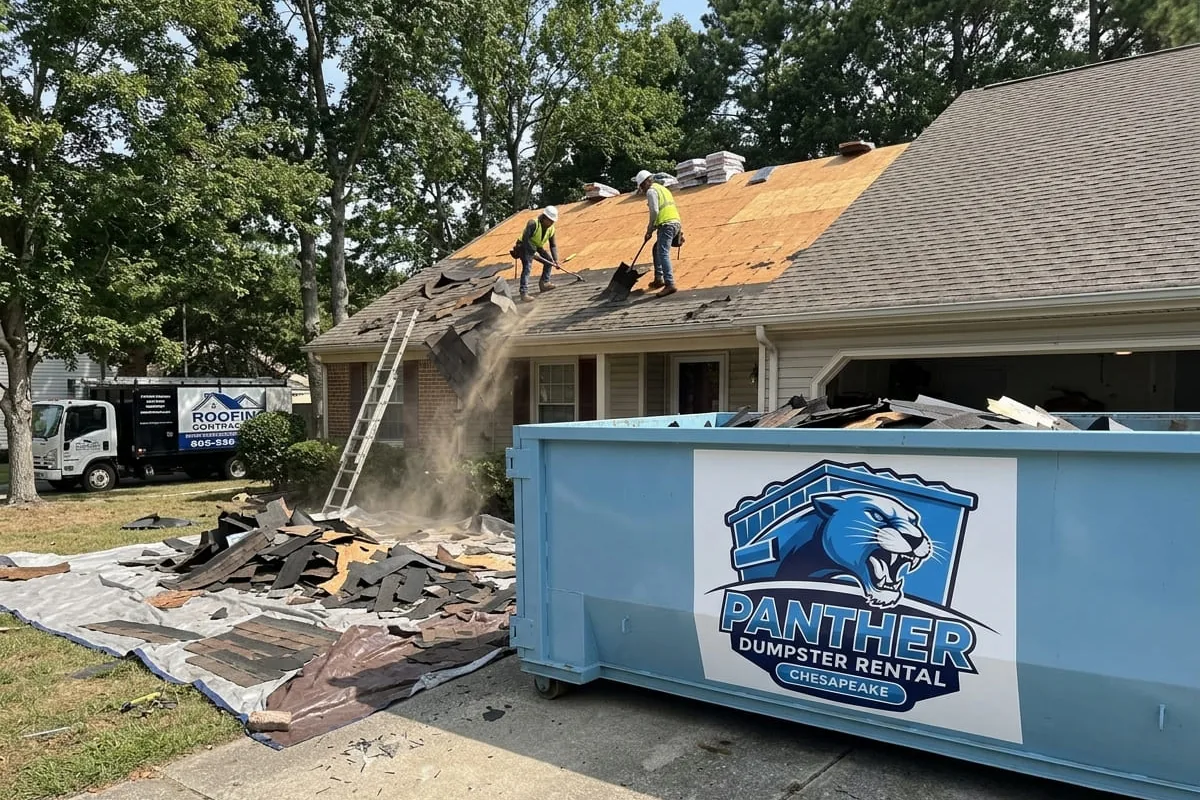
Roofing Dumpster Rental Chesapeake VA across Chesapeake and Portsmouth
Roofing is the one job where the sizing math is genuinely simple, which means there is little excuse for getting it wrong. A square of asphalt shingle runs somewhere in the neighborhood of 250 to 400 pounds depending on whether it is a standard three-tab or a heavier architectural product. Multiply that by the squares on the roof, then multiply again by the number of layers coming off. That number, not the size of the house, is what should decide the container.
Chesapeake's humid subtropical summers and its hurricane season, roughly June through November, both push work toward the calendar. Storm damage from a tropical system or a hard summer thunderstorm creates urgent tear-offs, while the sheer heat of a July or August afternoon can soften asphalt shingle enough to change how a crew handles it on the roof. Either way, placement and speed matter as much as the math once the tear-off actually starts.
The arithmetic that sizes the container
Work it as weight first, then check it against volume. A rough rule we use on the phone: figure roughly a ton and a half per 10 squares of single-layer architectural shingle, less for older three-tab product, and add close to a full layer's worth of weight for every additional layer underneath. Three layers on a mid-size roof adds up fast and will not fit in a small container regardless of how the volume looks.
- Up to about 20 squares, single layer — a 15 yard container is usually the right call
- 20 to 30 squares, or two layers — step up to a 20 yard
- Three layers, or a large roof with dormers and multiple pitches — plan on two pulls rather than one oversized container
- Cedar shake, slate or tile — call us first, since the weight per square is nothing like asphalt and the rules of thumb above do not transfer
Multi-pitch roofs and roofs with dormers deserve a second look before you size anything. The squares-and-layers math assumes a fairly uniform tear-off, and a roof with several distinct sections — a main body, a dormer, a porch roof at a different pitch — can end up with meaningfully more valleys, ridges and cut waste than a simple gable roof of the same total square footage. That extra cutting and fitting produces more debris per square than the straightforward version, so treat a complicated roofline as a reason to size slightly up rather than sticking strictly to the base calculation.
Why the biggest container is the wrong one for shingles
It feels efficient to order the largest box available and think about it once. With shingles it backfires. A 30 or 40 yard container will hit its weight allowance with the box still visibly empty, which means paying for volume the load can never physically use, and the walls sit high enough that shoveling over them from a roof edge is genuinely harder work than it needs to be. Big containers are built for light, bulky material — framing offcuts, general construction waste, packaging — not dense tear-off debris.
Low walls and an easy angle for shoveling beat raw capacity every time on a roofing job. If the roof genuinely produces more debris than one container can legally hold, two pulls of the right-sized box is the better plan, not one oversized container that never fills to a usable line.
Crew efficiency matters as much as the container math on a paid roofing job, and this is where the low-wall argument really pays off. A crew shoveling into a 15 or 20 yard spends its energy moving material, not fighting the height of the box, which on a job priced by the day or the square translates directly into how much roof actually gets stripped before the crew runs out of daylight. We would rather talk a roofer out of an oversized container up front than have that conversation after a slower-than-expected tear-off.
Placement on tight Chesapeake lots and streets
On a tight urban lot the container often has to sit on the street rather than the driveway, and that changes the paperwork. Private property placements never need a permit, but a container on a public street or sidewalk may need a temporary permit from the City of Chesapeake, so a street placement needs a bit of lead time rather than a same-day call. Where there is a driveway, we set the container as close to the eave as the approach allows and put boards under the rails so nothing marks the surface.
Old flashing, drip edge, valley metal and vent stacks come off during almost every tear-off, and pulling that metal into its own pile as the crew strips the roof keeps the shingle load clean and gives you a separate stream with real scrap value rather than mixed debris nobody wants to sort later.
Landscaping around the drop zone is worth a second thought on a roofing job specifically, since debris falls from height rather than being carried out by hand the way it is on most other services. Shrubs, flower beds and mulch directly under the eave line take the brunt of a tear-off, and while a crew's tarps handle most of it, positioning the container to shorten the throw from roof edge to box reduces both the mess on the ground and the time spent hand-carrying material across the yard. On corner lots or homes with landscaping wrapped close to the foundation, tell us which side of the house is being stripped so we can set the container with that throw distance in mind rather than defaulting to whichever spot is most convenient for the truck.
Underlayment, decking and what comes off besides shingles
A tear-off is rarely just shingles. Old felt or synthetic underlayment comes off with the shingles and adds its own weight, and on some jobs a section of decking has to come out too, whether from rot, storm damage, or a spot where the crew finds soft plywood once the shingles are stripped away. Decking is dense — plywood or OSB, sometimes with old nails still in it — and it is worth mentioning to us if a job is likely to include deck replacement rather than a straightforward strip-and-reroof, since it changes the weight math meaningfully.
Ridge caps, ridge vents and any old chimney or skylight flashing typically come off in the same pass as the shingles and underlayment, and none of it changes the basic sizing logic — dense material, sized by weight rather than by the footprint of the roof. Where it does matter is timing: a roof that turns out to need deck replacement mid-tear-off is a job that can suddenly need a bigger container or a faster swap than originally planned, particularly if the crew is racing weather during storm season.
- Mention likely deck replacement when you book, not after the tear-off uncovers it
- Underlayment adds real weight on top of the shingles — factor it into the estimate, not just squares of shingle
- Keep ridge vent, cap and flashing metal separate from the bulk shingle pile where practical
- Build in a size buffer on older roofs where hidden decking damage is more likely
Which size suits the job
Roofing sizing comes down almost entirely to squares and layers rather than the footprint of the house. A 15 yard handles most single-layer tear-offs up to about 20 squares. A 20 yard steps up for larger single-layer roofs or a straightforward two-layer tear-off. Anything past three layers, or a large roof with multiple pitches and dormers, is better planned as two pulls than forced into one container that cannot legally hold it all. Metal roofing, standing seam in particular, is a different animal from shingle entirely — it is much lighter by volume but the panels are long and awkward, so tell us specifically if that is what is coming off, since the loading approach and container choice both change.
- Count squares and layers before calling, not after the tear-off has already started
- Load flat and even rather than heaped at one end, since a lopsided load is harder and riskier to haul
- Pull flashing and metal into a separate pile as you strip rather than mixing it into the shingle load
- Book earlier than you think during hurricane season and the storm-repair rush that follows a tropical system
- Ask about a second container up front for a large, multi-pitch roof rather than discovering mid-job that one box will not cover it
Sizes
Which container for roofing dumpster rental?
Every service runs in all four sizes. Match the material to the weight allowance and the rest takes care of itself.
| Size | Dimensions | Capacity | Weight included | Best for |
|---|---|---|---|---|
| 10 Yard Dumpster | 12 ft long × 8 ft wide × 3.5 ft high | about 3 pickup truck loads | 1–2 tons | Small bathroom remodels, single-room cleanouts, concrete and heavy debris, roofing up to about 15 squares. |
| 15 Yard Dumpster | 16 ft long × 8 ft wide × 4 ft high | about 4–5 pickup truck loads | 2–3 tons | Attic and garage cleanouts, kitchen remodels, medium roof tear-offs, small deck removals. |
| 20 Yard Dumpster | 22 ft long × 7.5 ft wide × 4.5 ft high | about 6 pickup truck loads | 3–4 tons | Whole-home decluttering, flooring and siding jobs, large tear-offs, drywall and mud phases. |
| 30 Yard Dumpster | 22 ft long × 8 ft wide × 6 ft high | about 9 pickup truck loads | 4–5 tons | Full-house renovations, new construction, estate clearances, commercial fit-outs and demolition. |
| 40 Yard Dumpster | 22 ft long × 8 ft wide × 8 ft high | about 12 pickup truck loads | 5–6 tons | Large commercial fit-outs, industrial clear-outs, major renovations and high-volume light debris. |
Talk to a real person
Need roofing dumpster rental in Chesapeake?
Call (757) 432-2979 and describe the job. You will get a flat price and a delivery time on the same call — most orders before noon go out the same day.
Mon–Sat 7:00am – 6:00pm · Sun by appointment
Answers
Roofing Dumpster Rental — your questions
How many squares fit in a 20 yard dumpster?
As a working rule, a 20 yard handles roughly 25 to 30 squares of single-layer asphalt shingle, or about half that with two layers coming off. Architectural shingle runs heavier than three-tab, so shade your estimate down if the roof has thicker laminated product. Tell us squares and layers on the phone and we will size the container for you.
Why not just get the biggest dumpster for a roof tear-off?
Because shingles are dense enough to hit the weight allowance while a large container still looks mostly empty, which means paying for space you cannot legally fill. The walls on a big box are also taller, which makes shoveling from a roof edge harder. Two pulls of the right-sized container almost always beats one oversized box on a roofing job.
Can the dumpster sit on the street for a roofing job?
Often, especially on tight urban lots with no other placement option. A container on private property, including your driveway, never needs a permit. One sitting on a public street or sidewalk may need a temporary permit from the City of Chesapeake, so give us a bit of notice if that is the only spot available rather than assuming it can happen the same day.
What do I do with old flashing and roof metal?
Keep it separate from the shingle load as you strip the roof. Drip edge, step and valley flashing, and old vent stacks all pull out during a typical tear-off, and staging that metal on its own rather than mixing it into the general container keeps the shingle load clean and gives you a stream with real recycling value.
When should I book a roofing container during hurricane season?
As early as you can, particularly from June through November when tropical systems and heavy summer thunderstorms drive up storm-repair demand across South Hampton Roads. We keep capacity back for live jobs, but a crew scheduled for a specific day should have the container booked for that same day rather than assumed.
Service area
Roofing Dumpster Rental across South Hampton Roads
We run roll-off dumpsters out of our 2324 Chesapeake Square Ring Rd yard across every corner of Chesapeake — from Great Bridge and Greenbrier out to Deep Creek, Western Branch and South Norfolk, down to Hickory and Grassfield near the North Carolina line, and across the city lines into Portsmouth, Suffolk and Virginia Beach. If your neighborhood is not on this list, call us anyway. We probably still get there.