Dumpster Rental Cost in Chesapeake, VA | Panther
Flat-rate dumpster pricing in Chesapeake isn't one number for every job. Here's what's actually built into that price, and what pushes it up.
ReadChesapeake, VA guide
Weight and volume aren't the same limit. Here's how to size a roll-off correctly for your material, plus real driveway access numbers for Chesapeake.
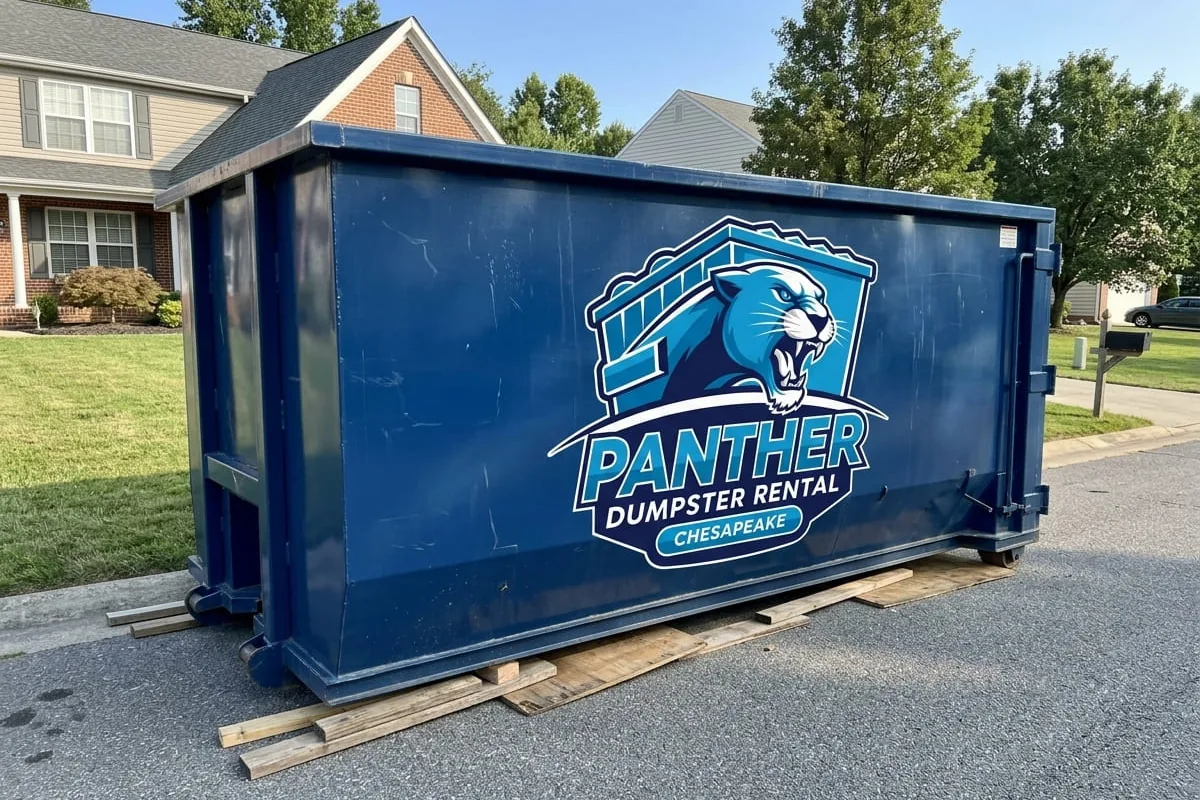
Every call starts the same way: "How big a dumpster do I need?" The honest answer is that most people are asking the wrong half of the question. Size on a spec sheet is cubic yards — length times width times height. But the thing that actually stops a container is weight. Roll-offs ride on a single-axle or tandem-axle trailer, and every size we own has a tonnage allowance built into the price. Fill a 20 yard with shingles or wet concrete and you can hit its weight limit with the box still looking half empty. Fill that same 20 yard with old furniture and carpet padding and you'll run out of room long before you're anywhere near the tonnage cap. Getting the size right means matching the box to whichever limit your material hits first, and that's the whole point of this guide.
Dense material — shingles, concrete, brick, dirt, tile, drywall scrap — is heavy for its size. A pickup-truck load of roofing shingles can weigh 700-800 pounds by itself. Stack that into a 30 yard box and you'll blow past the tonnage allowance while the container still has ten feet of empty headroom above the debris. For roofing tear-offs, concrete removal, brick, and dirt, the move is almost always to go smaller on the box and let weight, not volume, drive the size you rent.
Bulky, light material is the opposite problem. Old couches, mattresses, cabinetry, storm-damaged fencing, tree brush — none of it weighs much per cubic foot, but it eats space fast because it doesn't compact and it doesn't stack cleanly. A living room's worth of furniture will fill a 20 yard container to the brim while the scale ticket comes back under a ton. For garage cleanouts, attic cleanouts, furniture hauls, and storm debris, volume is almost always the limiting factor, not weight.
Mixed loads — a typical whole-property cleanout with a bit of everything — usually land somewhere in between, which is exactly why the 20 and 30 yard sizes are our best sellers. They give you enough tonnage headroom to absorb a few heavy items without maxing out, and enough cubic footage to swallow bulky stuff too, without you having to sort the load in advance.
Here's what we actually run out of our yard on Chesapeake Square Ring Rd, with real dimensions, not rounded marketing numbers.
| Size | Dimensions (L x W x H) | Holds About | Weight Allowance | Best For |
|---|---|---|---|---|
| 10 yard | 12 ft x 8 ft x 3.5 ft | 3 pickup truck loads | 1-2 tons | Small cleanouts, single-room gut, yard debris, minor shingle tear-off |
| 15 yard | 16 ft x 8 ft x 4 ft | 4-5 pickup truck loads | 2-3 tons | Garage or shed cleanout, deck removal, mid-size renovation |
| 20 yard | 22 ft x 7.5 ft x 4.5 ft | 6 pickup truck loads | 3-4 tons | Whole-house cleanout, roofing job on a typical home, flooring tear-out |
| 30 yard | 22 ft x 8 ft x 6 ft | 9 pickup truck loads | 4-5 tons | New construction, home additions, major remodels |
| 40 yard | 22 ft x 8 ft x 8 ft | 12 pickup truck loads | 5-6 tons | Commercial demolition, large-scale construction and gut jobs |
The 10 yard is our smallest box and it's the right call more often than people expect, mostly because it's the right size for heavy material. A single-layer shingle tear-off on a small to mid-size roof, a concrete driveway apron demo, a garage floor's worth of old tile, or clearing out one room of furniture and boxes — all of that fits a 10 yard, and in most of those cases the 1-2 ton allowance is the actual ceiling, not the 12x8 footprint. If your job is "small but heavy," don't upsize just because 10 yards sounds tiny on paper. It's not built for volume, it's built for density, and paying for a bigger box you'll never fill by weight is money wasted.
These two sizes cover the bulk of what we deliver across Chesapeake, Portsmouth, Suffolk, and Virginia Beach, and picking between them usually comes down to how much of the house you're clearing and how heavy the mix runs.
A garage cleanout, a shed teardown, deck board and railing removal, or a mid-size bathroom or kitchen remodel typically lands here. It's also a solid pick for a moderate roofing job — more shingles than a 10 yard can handle weight-wise, but not a whole two-story roof. The 2-3 ton allowance gives you room for a mix of debris without pushing the limit the way a smaller 10 yard would on the same job.
This is the size we sell the most of, and for good reason — it's the sweet spot for a full home cleanout. Chesapeake homes are overwhelmingly slab or crawlspace construction rather than basement, since the water table sits so close to the surface here, so a "whole house" cleanout in this area usually means attic, garage, closets, and living space, not multiple floors of dense basement storage. A 20 yard handles that combination well: enough cubic footage for furniture and boxes, enough tonnage allowance to absorb flooring tear-out or a stack of drywall without maxing out. It's also the standard choice for a full roof replacement on an average single-family home in this area.
Once you're past a single room or a routine cleanout and into structural work, you need both the cubic footage and the tonnage to match, and this is where the two biggest boxes we run come in.
New home construction, room additions, whole-kitchen guts down to the studs, and major remodels generate a volume of debris — framing offcuts, old cabinetry, drywall, flooring, packaging — that a 20 yard simply can't hold. At 22 ft x 8 ft x 6 ft with a 4-5 ton allowance, it's built for bulk plus a reasonable amount of weight, which matches what a construction crew actually generates day to day on a residential job site.
Our largest box, at 22 ft x 8 ft x 8 ft with a 5-6 ton allowance, is for commercial demolition and large-scale construction — think a full commercial buildout, a large home teardown, or a job generating enough debris that you'd otherwise need multiple 30 yard swaps in a week. It's the tallest box we run, which matters for site planning: at 8 feet of height, loading it fully by hand gets difficult past the halfway mark, so it works best with equipment on site to load it — a skid steer or excavator — rather than a crew tossing debris over the wall by hand.
Size on paper doesn't matter if the truck can't place the box where you need it. A loaded roll-off truck needs roughly 60 feet of straight approach to back in and set the container down cleanly, plus about 23 feet of overhead clearance — that rules out placement under low tree canopy, which is common on older lots around the city, and under low carport or garage roof lines near the street.
On the ground, plan for footprint plus swing room. A 10 or 15 yard needs about 20 feet of driveway length; a 20, 30, or 40 yard needs closer to 27 feet, since the box itself is the same 22-foot length across those three sizes and only the height changes between them. Add roughly 10 feet of width beyond the container itself so the truck has room to angle the doors open and drag the box off the rails without clipping a fence, mailbox, or parked car in a tight driveway.
If your driveway is short, curved, or lined with mature trees — more common on the older streets in Chesapeake and Portsmouth than in newer Suffolk or Virginia Beach subdivisions — tell us before delivery. We'd rather talk through street placement or a different container size on the phone than have a driver show up and find there's no way to set the box down safely. During hurricane season, roughly June through November, we also factor storm debris and downed limbs into placement, since a driveway that's clear in April can have a fallen branch or standing water blocking the approach by September. Hot, humid Tidewater summers also mean asphalt and gravel driveways soften under a loaded container's weight faster than in cooler climates, so we try to avoid parking a full box on the same soft spot for the entire rental period when we can help it.
Call us before you guess. We deliver these same five sizes across Chesapeake, Portsmouth, Suffolk, and Virginia Beach every week, and matching the container to whichever limit — weight or space — your material actually hits first is the difference between one clean pickup and a second truck roll you didn't budget for.
Talk to a real person
Call and describe the job. Flat price, stated tonnage, and a delivery time on the same call.
Mon–Sat 7:00am – 6:00pm · Sun by appointment
From this guide
Think about the material, not just the pile size. Shingles, concrete, brick, tile, dirt, and drywall scrap are dense and heavy per cubic foot, so they tend to hit the tonnage allowance while the container still looks partly empty. Furniture, mattresses, cabinetry, and yard brush are bulky but light, so they fill the box visually long before the scale ticket gets close to the weight limit. If you're not sure which category your job falls into, describe it to us on the phone and we'll size it based on both dimensions.
For most single-family homes here, a 20 yard is the standard call. Since Chesapeake construction is overwhelmingly slab or crawlspace rather than basement, a full cleanout usually means garage, attic, closets, and living space rather than a basement's worth of dense storage, and the 20 yard's mix of cubic footage and tonnage allowance matches that combination well. Smaller single-room jobs often only need a 10 or 15 yard.
Plan for roughly 60 feet of straight approach for the truck to back in and place the box, plus about 23 feet of overhead clearance for tree limbs, power lines, or carport roofs. On the ground, a 10 or 15 yard needs about 20 feet of driveway length and a 20, 30, or 40 yard needs closer to 27 feet, plus about 10 feet of width beyond the container so the truck can swing the doors and drag the box off the rails.
You can, but you shouldn't default to a big box for shingles. They're one of the heaviest common materials by volume, and a full-size roof tear-off can max out the weight allowance on a 20 or 30 yard while the container still has plenty of visible space left. For most single-layer roofing jobs on an average home, a 10 or 15 yard sized around the tonnage allowance is the more cost-effective call.
Yes. Along with Chesapeake, we regularly deliver across the rest of South Hampton Roads — Portsmouth, Suffolk, and Virginia Beach. Access considerations like driveway length and overhead clearance apply the same way in each of those cities, so let us know your address and any tight spots when you call so we can size and place the container correctly on the first trip.
Keep reading
Flat-rate dumpster pricing in Chesapeake isn't one number for every job. Here's what's actually built into that price, and what pushes it up.
ReadA straight answer on what belongs in your roll-off and what doesn't, plus where Chesapeake-area homeowners take the stuff that isn't allowed.
ReadMost driveway dumpster rentals in Chesapeake need no permit at all. Here's exactly when the City of Chesapeake does require one, and how the process works.
Read