Whole-Home Cleanout Checklist | Chesapeake, VA
Downsizing, decluttering, or prepping to sell? Here's a room-by-room Chesapeake cleanout checklist, plus how to size the dumpster right the first time.
ReadChesapeake, VA guide
A loaded dumpster can dent asphalt or crack a stressed slab in hours. Here's what actually causes driveway damage and how to prevent it.
Every year we deliver hundreds of roll-off containers across Chesapeake, Portsmouth, Suffolk, and Virginia Beach, and the single most common question we get before drop-off isn't about size or pricing — it's "will this damage my driveway?" It's a fair question, and the honest answer is: it can, if the container sits in the wrong spot on the wrong surface without protection. But driveway damage from a dumpster rental is almost always preventable once you understand what's actually causing the stress. This guide covers the real mechanics of it, not the sales pitch version.
Most homeowners assume the delivery truck is the risk — a rolling vehicle with a loaded box on the back seems like the heaviest thing to hit the driveway. In practice, the truck is only in contact with your driveway for a minute or two while it positions and slides the container off. The truck's weight is spread across multiple axles and tires, so the load per square inch is relatively modest, similar to any delivery vehicle or moving truck that already visits your property.
The container is a different story. A steel roll-off box rests on two narrow rails that run the length of its underside, and once it's set down, that's where 100% of its weight — plus everything you load into it — concentrates. A 20-yard container full of construction debris or shingles can weigh several tons, and all of that comes down through two thin steel edges rather than a wide, evenly distributed footprint. That's a point-load, in the engineering sense: a lot of force pressed into a small contact area. Point-loads are what dent asphalt, crack marginal concrete, and rut soft ground. It's not the weight alone that causes damage — it's the weight divided by a small area, sitting in one place for days at a time while you fill it.
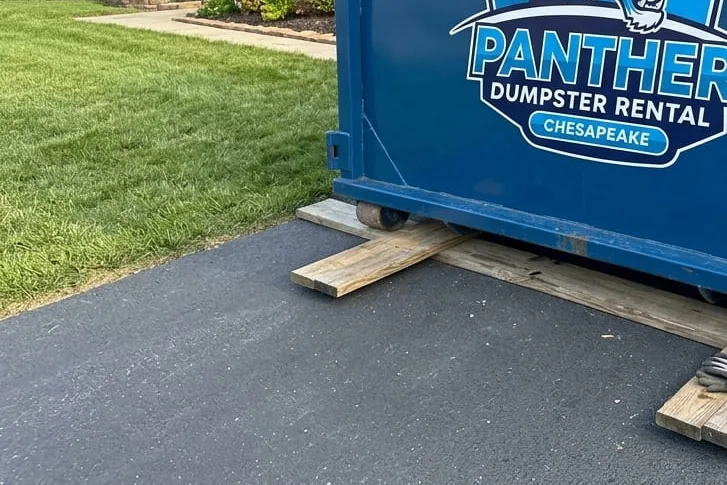
The fix for a point-load problem is straightforward: increase the contact area. That's what wood protection does. When our crew lays 2-inch dimensional lumber or sheets of 3/4-inch plywood under the container's rails before it's set down, the container's weight is no longer pressing into two thin steel lines — it's spread across several square feet of board. The math is simple but effective: the same total weight distributed over a much larger surface means far less pressure at any single point, which is exactly what a driveway surface can tolerate without deforming.
This isn't a courtesy add-on. It's the single most effective thing that happens during delivery to protect your surface, and it takes the crew only a couple of extra minutes. Boards also help the container settle level rather than digging in unevenly if the driveway has a slight crown or grade, which reduces the chance of the box rocking or shifting once it's loaded.
Asphalt is a petroleum-based product, and its behavior changes with temperature. In cooler months it's rigid and holds up well under a parked container. In the middle of a Hampton Roads summer, when pavement surface temperatures regularly climb well above the surrounding air temperature, asphalt softens. That softened state is exactly when it's most vulnerable to indentation — a container's rails can press shallow grooves or depressions into hot asphalt over the days it sits, especially if it's parked in direct sun for a multi-day rental during July or August.
This is real material science, not a scare tactic. It's also why timing matters: if you have flexibility on delivery day and the surface is asphalt, an early morning drop-off before the pavement has fully heated, or choosing a shaded section of the driveway, both reduce risk. Board protection matters more on asphalt than on almost any other surface precisely because the material itself is temporarily less able to resist point-load pressure during peak heat.
Concrete doesn't soften in the heat the way asphalt does, but it has its own failure mode: it's rigid and doesn't flex, so if a slab already has a hairline crack, an expansion joint under strain, a void underneath from erosion or settling, or was poured thin in one section, a concentrated point-load can be the thing that turns an invisible weak spot into a visible crack or a broken corner. Older concrete driveways, sections near a garage apron, or areas where a tree root has lifted the slab slightly are the spots we watch most closely.
Because concrete cracking is usually about a pre-existing weak point rather than the surface softening like asphalt, the fix is less about timing and more about placement. Walking the surface before the container goes down, and steering clear of any section with visible cracking, is more useful on concrete than picking a cooler hour of the day.
Gravel and paver driveways behave differently again. Loose gravel can shift and rut under the truck's tires during positioning, and pavers can shift out of their bedding sand if the container's rails sit directly on them for an extended rental. The bigger factor on unpaved or semi-paved surfaces in this region is moisture. Hurricane season in Hampton Roads runs roughly June through November, and it's common for a dumpster to be delivered or picked up during or right after a heavy rain event. Wet gravel or wet dirt underneath a paved apron loses compaction strength quickly — a fully loaded truck backing across softened ground can rut it in a way that dry ground never would.
For gravel and paver driveways, we still use board protection under the container rails, but we also pay closer attention to the truck's path in and out, and we'll talk with you about rescheduling a delivery or pickup if the ground is genuinely saturated rather than just damp.
| Surface Type | Primary Risk | When Risk Is Highest | Protection Approach |
|---|---|---|---|
| Asphalt | Indentation from softened surface under point-load | Hot summer afternoons, direct sun | Boards/plywood under rails; early delivery or shaded placement in peak heat |
| Concrete | Cracking at existing weak points or joints | Slabs with cracks, thin pours, or nearby root heave | Careful spot selection; boards under rails to reduce point-load |
| Gravel | Rutting and displacement under truck tires | After rain, saturated hurricane-season conditions | Boards under container; crew manages truck path; reschedule if saturated |
| Pavers | Shifting out of bedding sand under sustained weight | Long rental durations, full loads | Boards spanning multiple pavers under rails |
| Grass/dirt | Rutting and compaction damage | Wet ground, soft soil | Boards or plywood path; often better to place on driveway instead |
When a Panther Dumpster Rental truck arrives in Chesapeake, Portsmouth, Suffolk, or Virginia Beach, the driver doesn't just back up to the nearest flat spot and drop the box. The routine is consistent on every job:
If you have a preference for exactly where the container sits — further from the garage door, off to one side of the driveway, angled toward the street — tell the driver when they arrive or let our office know ahead of time. A few minutes of planning before drop-off solves most placement problems before they start.
Homeowners aren't powerless here, and a little prep goes a long way:
None of this requires special equipment or expertise on your part — it's mostly about a five-minute walk around the driveway before delivery day and flagging anything that looks fragile. Combined with a crew that takes placement seriously, it's enough to prevent the vast majority of driveway issues we see reports of elsewhere in the industry.
Even with protection, driveways that are already in poor condition — badly alligator-cracked asphalt, a slab with a known structural crack, or gravel that's essentially just loose fill over soft soil — carry some risk no matter how careful the placement is. In those cases, the honest move is a conversation before delivery about alternative placement, such as a spot on the street (where permitted) or a driveway section in better shape, rather than promising zero risk on a surface that's already compromised. We'd rather have that conversation up front than have you surprised afterward.
If you're planning a project in Chesapeake, Portsmouth, Suffolk, or Virginia Beach and want to talk through the best container placement for your specific driveway, call Panther Dumpster Rental at (757) 432-2979. We're based at 2324 Chesapeake Square Ring Rd in Chesapeake, and walking a driveway with a customer before delivery day is a normal part of how we do business, not an extra step.
Talk to a real person
Call and describe the job. Flat price, stated tonnage, and a delivery time on the same call.
Mon–Sat 7:00am – 6:00pm · Sun by appointment
From this guide
Not if it's placed correctly. Damage happens when a container's steel rails press directly onto asphalt or a stressed concrete slab without any weight-distributing protection underneath. With boards or plywood under the rails and a careful look at the surface beforehand, the vast majority of driveways come through a rental with no issues at all.
It depends on conditions. Asphalt is more at risk during hot Chesapeake summer days because heat softens the material and makes it more vulnerable to indentation under a point-load. Concrete doesn't soften in heat, but it can crack at pre-existing weak spots, thin sections, or old joints under the same concentrated weight. Both benefit from board protection under the container's rails.
Our delivery drivers assess the surface on arrival and use board or plywood protection under the container rails as standard practice, particularly on asphalt, pavers, and gravel. If you have a specific concern about a fragile section of driveway, mention it when you book or tell the driver directly so they can plan placement around it.
Usually not. Grass and dirt compact and rut easily under the truck's weight, especially if the ground is wet, which is common during hurricane season in this area. A paved driveway with proper board protection under the container is typically the more forgiving surface, though we can discuss placement options if your driveway has limited space or existing damage.
Point it out to the driver when they arrive, or let us know when you schedule the rental. We'll position the container away from that section where possible, or discuss an alternative placement such as a different part of the driveway or the street where local rules allow it.
Keep reading
Downsizing, decluttering, or prepping to sell? Here's a room-by-room Chesapeake cleanout checklist, plus how to size the dumpster right the first time.
ReadA practical, no-filler guide to how recycling and disposal actually work in Chesapeake, VA, including what a dumpster can and can't take.
ReadWeight and volume aren't the same limit. Here's how to size a roll-off correctly for your material, plus real driveway access numbers for Chesapeake.
Read